


Open
[Special Exhibition]
A World of Flowers 2026―Yokoyama Taikan’s Cherry Blossoms, Kawabata Ryūshi’s Peonies and Hayami Gyoshū’s Plum Blossoms―

Nihonga, a general term for traditional Japanese painting, means, literally, "Japanese painting".
Now in common use, this term originated during the Meiji period, to distinguish Japanese painting
from Western-style oil painting. The distinction between Western-style oil painting and nihonga is
thus, broadly speaking, the difference in the painting materials used. While some would argue that
anything a Japanese artist paints is nihonga, the distinction based on materials continues to be
used.
The term nihonga was already in use in the 1880s. Prior to then, from the early
modern period on, paintings were classified by school: the Kanō school, the Maruyama-Shijō school,
and the Tosa school of the yamato-e genre, for example. At about the time that the Tokyo Fine Arts
School was founded, in 1887, art organizations began to form and to hold exhibitions. Through them,
artists influenced each other, and the earlier schools merged and blended. With the additional
influence of Western painting, today's nihonga emerged and developed.
Today, however,
techniques, sensibilities, aesthetics, and styles based on tradition are changing with the times.
Moreover, the question continues to be raised of what nihonga is and whether the distinction between
nihonga and Western-style painting has any validity in terms of painterly expression.
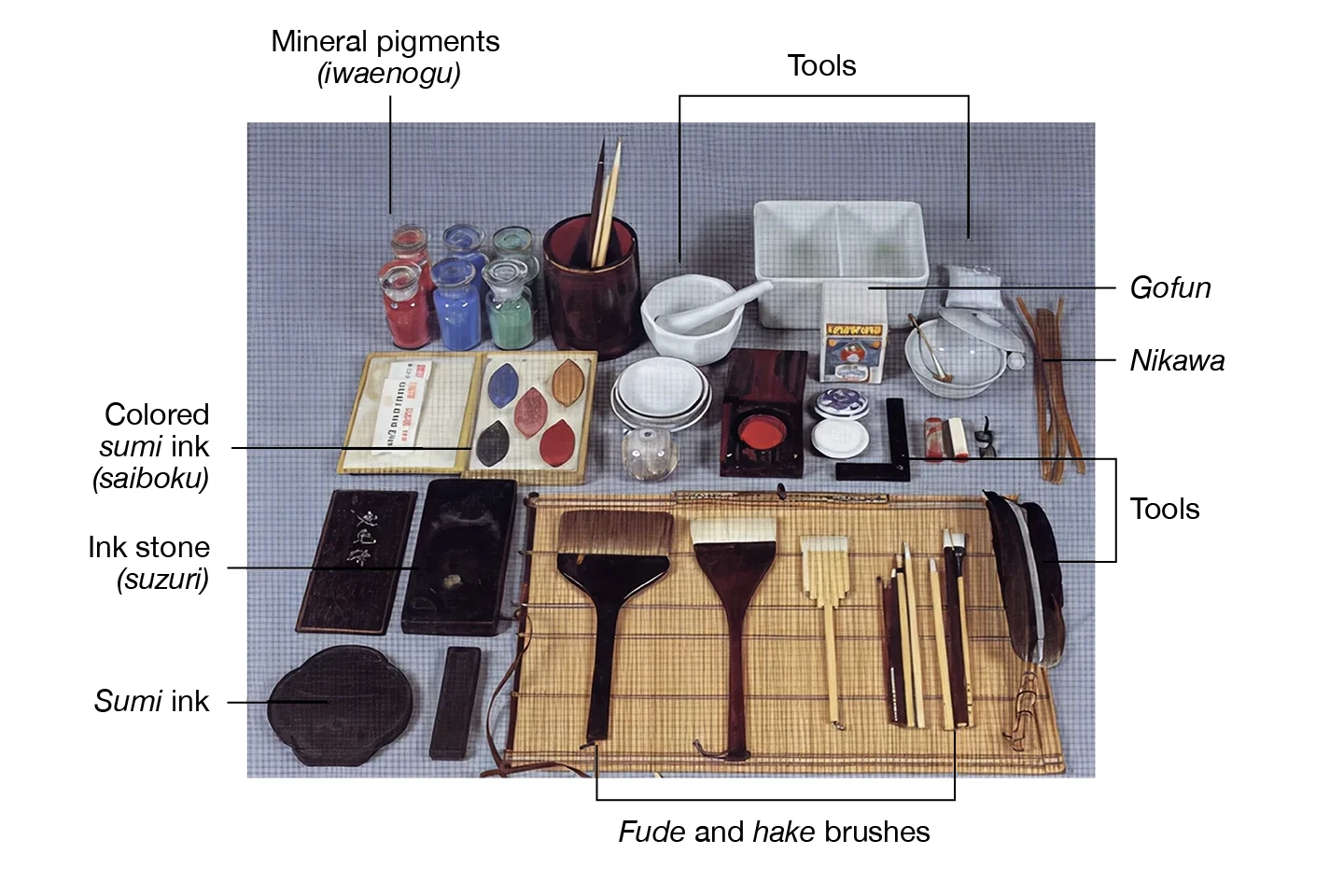
Nihonga is based on painting styles that have evolved for over a thousand years. The materials used
are also traditional elements developed during that long history. In general, the support is paper,
silk, wood, or plaster, to which sumi ink, mineral pigments, white gofun (a white pigment made from
pulverized seashells), animal or vegetable coloring materials, and other natural pigments were
applied, with nikawa, an animal glue, as the adhesive. Gold and other metals (in gold leaf and other
forms) were also effectively incorporated in paintings.
Those materials are not easy to
use. Mastering the necessary techniques requires considerable time and determination. Artists
continue to use them, however, because the resulting nihonga style suits the natural features of
Japan and the Japanese aesthetic sense and spiritual qualities.
Reference materials


