


Next
[Special Exhibition]
A World of Flowers 2026―Yokoyama Taikan’s Cherry Blossoms, Kawabata Ryūshi’s Peonies and Hayami Gyoshū’s Plum Blossoms―

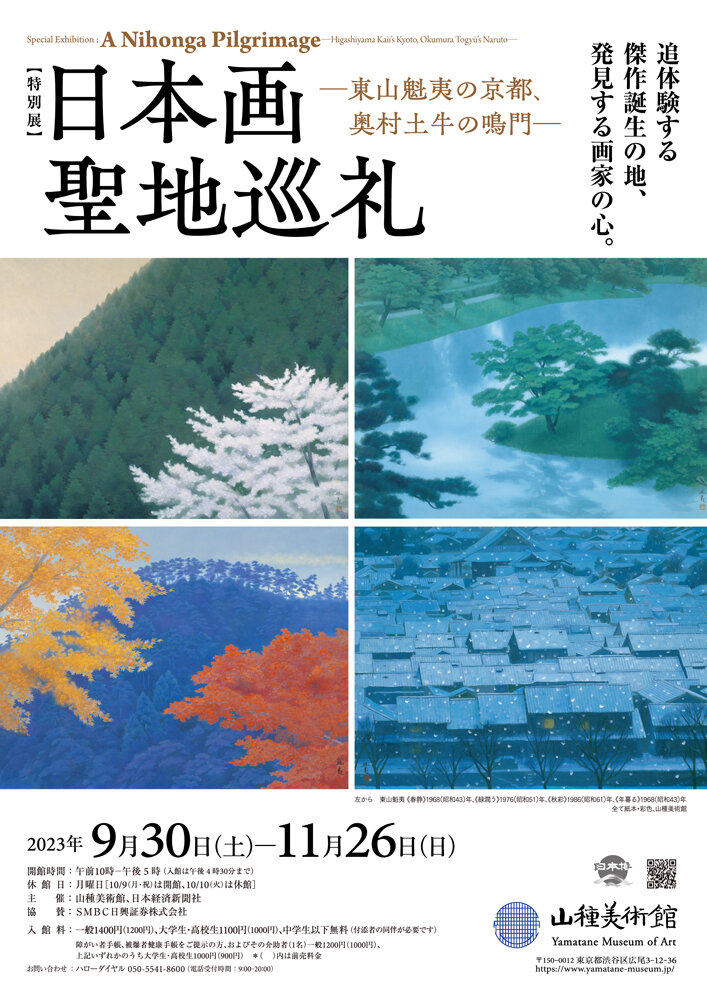
Pilgrimages, journeys to sacred places, now include expeditions to places that are the settings for movies, novels, manga, and anime. In the world of painting, a pilgrimage might take one to places that were the subject of works or that have deep ties to artists. For this exhibition, the Yamatane Museum of Art defines sacred places as places that distinguished nihonga artists actually visited and depicted. We are delighted to present an exhibition that gives visitors a taste of a Nihonga Pilgrimage, within our museum.
Hayami Gyoshū’s masterpiece, Camellia Petals Scattering (Important Cultural Property) depicts a famous tree, the five-colored, double-blossom, scattering camellia at the Tsubakidera Jizōin temple in Kyoto. Comparing the painting with the actual scene, however, we can see that Gyoshū has reduced the number of blossoms and petals but made them larger, for a dramatically designed effect. Viewing the actual site not only lets us vicariously experience the artist’s gaze but also discover creative touches he has added. Those discoveries are the thrill of this Nihonga Pilgrimage.
An examination of our collection identified more than 150 works for which the locations of their settings could be confirmed. This exhibition introduces a thoughtful selection of those paintings.This exhibition includes Maelstroms at Naruto by Okumura Togyū, who sketched the whirling tides at the Naruto strait again and again, End of the Year by Higashiyama Kaii, who painted scenes with the machiya of Kyoto viewed from the inn where he usually stayed, and Cherry Tree in the Morning Sun by Hashimoto Meiji, who painted the Miharu Takizakura, a weeping cherry tree said to be over a thousand years old in Miharu, Fukushima prefecture. These pilgrimage stops are joined by many others, from Hokkaido to Okinawa, superb works with places throughout Japan as their subjects. Observing each with the artist’s comments about the context, sketches made at the site, and photographs of it offers a delightful Nihonga Pilgrimage to the special places that these painters discovered, to sacred places associated with famous paintings.
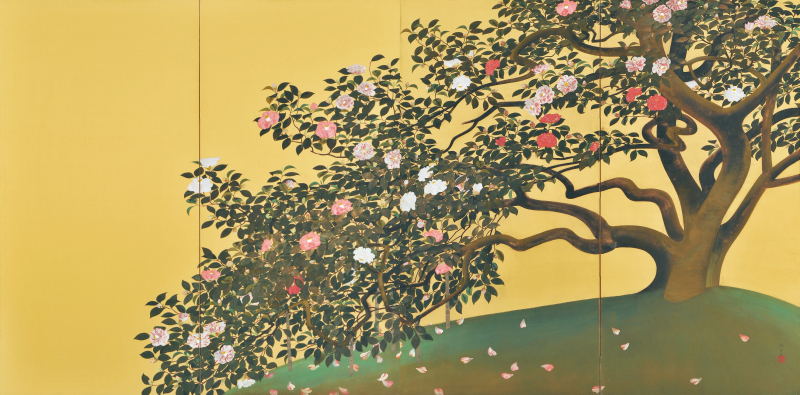 Hayami Gyoshū,
Okuda Gensō, Oirase Ravine: Autumn. Color on Paper, Shōwa Period, 1983; Yamatane Museum of Art
Kawabata Ryūshi, Moonlight. Color on Silk, Shōwa Period, 1933; Yamatane Museum of Art
Yokoyama Taikan, Kegon Falls. Ink and Light Color on Silk, Shōwa Period, 1932; Yamatane Museum of Art
Kawai Gyokudō, Chikubu Island with Mountains. Color on Silk, Showa Period, 1928; Yamatane Museum of Art
Yamaguchi Kayō, Spirit of the Forest (Dryad). Color on Paper, Shōwa Period, 1976; Yamatane Museum of Art
Higashiyama Kaii, Spring Calm. Color on Paper, Shōwa Period, 1968; Yamatane Museum of Art
Higashiyama Kaii, Pervasive Verdure. Color on Paper, Shōwa Period, 1976; Yamatane Museum of Art
Yoshida Yoshihiko, Great Buddha Hall in Spring Snow. Color on Paper, Showa Period, 1969 ☆
Imamura Shikō, Kenreimon-in at Ōhara: Scene from the Tale of the Heike. Color on Silk, Meiji Period, 1909; Yamatane Museum of Art
Kobori Tomoto, Nasu no Yoichi (Munetaka) Trying to Hit a Swinging Fan with an Arrow: Scene from the Tale of the Heike. Color on Silk, Meiji Period, 1890; Yamatane Museum of Art
Haneishi Kōji, Priest Saigyō on Mt. Yoshino. Color on Paper, Shōwa Period, 1987; Yamatane Museum of Art
Approximately 50 works in total are to be displayed.
Works are the property of the Yamatane Museum of Art, except for works with ☆ marks.
Adults: 1,400 yen; University and high school students: 1,100 yen; middle school and younger children: free of charge;
Disability ID holders and one accompanying person: 1,200 yen each
* Discount for those who are wearing kimono: Discount of 200 yen for adults


