


Open
[Special Exhibition]
A World of Flowers 2026―Yokoyama Taikan’s Cherry Blossoms, Kawabata Ryūshi’s Peonies and Hayami Gyoshū’s Plum Blossoms―

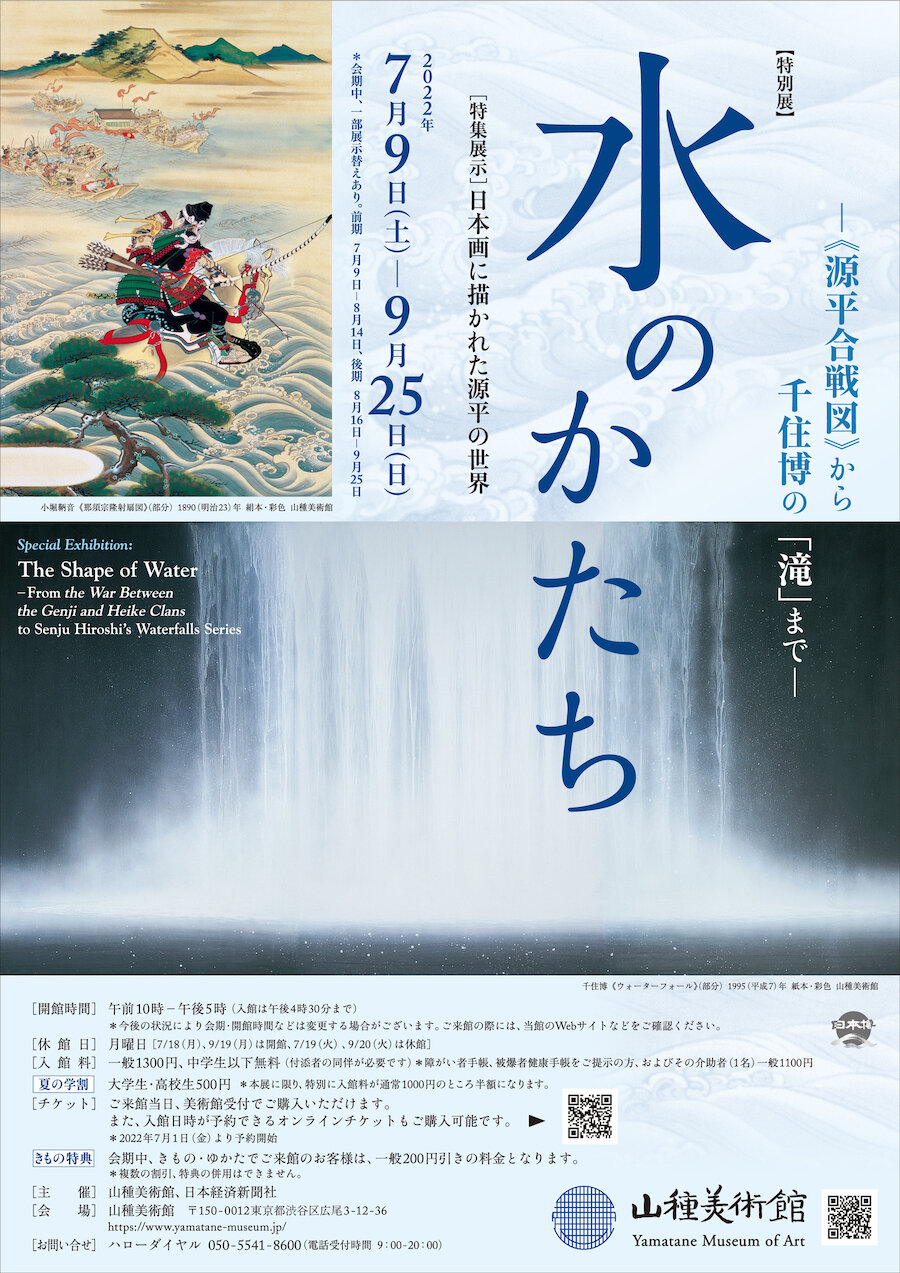
For the summer of 2022, the Yamatane Museum of Art will hold a refreshing exhibition with water as its theme.
Japan, surrounded by seas on all sides, has a moist climate with ample rainfall. Water is thus a familiar presence and one that has long been depicted in paintings of famous places, landscape paintings, picture scrolls, and other formats and a variety of themes. Since the beginning of the modern period, water has been an important motif in nihonga as well, from landscape paintings with the sea, lakes, rivers, or waterfalls as their themes to history paintings depicting waterside scenes. The water motif can be found in a broad range of works, regardless of period or genre.
Artists deftly capture its mutable appearance and, with their individual sensibilities and skills, render the forms of water in a host of distinctive ways.
This exhibition presents masterworks impressively depicting the many faces of water. War Between Genji and Heike Clans (from the Tale of the Heike) is set at the seashore. Utagawa Hiroshige’s pictures of famous places on display include A Hundred Famous Views of Edo: Evening Shower at Ōhashi Bridge, famed as a masterly depiction of rain. Kawabata Ryūshi’s The Black Current presents the ocean though a lavish use of azurite blue pigment. Ode to Mountain Ranges and Flowing Waters☆, Matsuo Toshio’s masterpiece, is an ink wash painting depicting a Chinese landscape in its mysterious profundity. The exhibition also includes Senju Hiroshi’s Waterfalls Series, which has become synonymous with that artist.
During summer’s intense heat, we hope visitors will enjoy the many shapes of water, expressed in many ways by Japanese artists, in our refreshingly cool galleries.
Utagawa Hiroshige, Fifty-three Stations of the Tōkaidō Road: Kanbara (Evening Snow). Large Format (Ōban) Polychrome Woodblock Print (Nishiki-e) on Paper, Edo Period, c. 1833-36; Yamatane Museum of Art ●
Yokoyama Taikan, Sea in Summer. Color on Paper, Shōwa Period, c. 1952; Yamatane Museum of Art
Kawai Gyokudō, Lake in a Snowstorm. Ink and Light Color on Silk, Showa Period, 1942; Yamatane Museum of Art
Hishida Shunsō, After the Rain. Color on Silk, Meiji Period, c. 1907; Yamatane Museum of Art
Okumura Togyū, Maelstroms at Naruto. Color on Paper, Showa Period, 1959; Yamatane Museum of Art
Yamamoto Kyūjin, Song of a Flowing Stream. Color on Paper, Showa Period, 1974; Yamatane Museum of Art
Imamura Shikō, Kenreimon-in at Ōhara: Scene from the Tale of the Heike. Color on Silk, Meiji Period, 1909; Yamatane Museum of Art
Kayama Matazō, Waves. Ink and Color on Paper, Showa Period, 1979; Yamatane Museum of Art
Yasuda Yukihiko, Minamoto no Yoshitsune in Hiraizumi. Color on Paper, Showa Period, 1965; Yamatane Museum of Art
Approximately 50 works in total are to be displayed.
Adults: 1,300 yen; university and high school students: 1,000 yen; middle school and younger children: free of charge;
Summer Student Discount: University and high school students: 1,000 yen → 500 yen
Disability ID holders and one person accompanying them: 1,100 yen
* Discount for those who are wearing kimono: Discount of 200 yen for adults


