


Open
[Special Exhibition]
A World of Flowers 2026―Yokoyama Taikan’s Cherry Blossoms, Kawabata Ryūshi’s Peonies and Hayami Gyoshū’s Plum Blossoms―

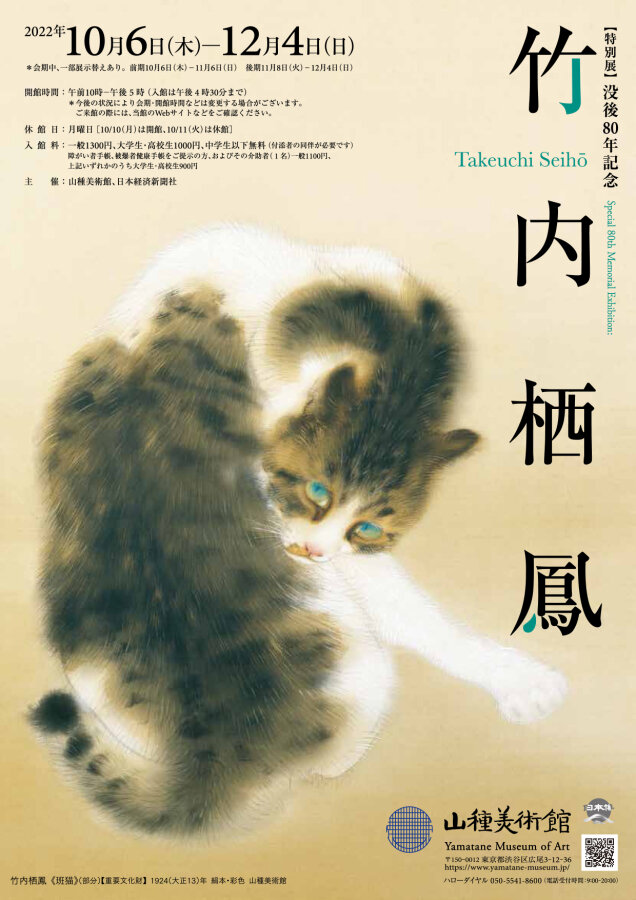
Takeuchi Seihō (1864-1942) was a central figure in the art world in modern Kyoto. Although Seihō was trained in the traditions of the Maruyama Shijō School, which dates back to the Edo period, he also studied the classics. His talent blossomed early, and by the time he was in his thirties, he was the leading painter in the Kyoto art world. In 1900, he traveled to Europe to observe the Paris Exposition. Seihō was deeply excited by the art he saw in Europe. After his return to Japan, he brought innovation to modern nihonga by incorporating the techniques of Western painting and by developing a unique style that also included ink paintings and other Eastern traditions. According to Hashimoto Kansetsu (1883-1945), one of Seihō’s pupils, Seihō himself said that when he painted animals, he could paint them down to their smell. His descriptive powers where highly acclaimed at the time, and their appeal remains fresh to this day. As well as being an artist, Seihō was also an outstanding educator. He was committed to the development of nihonga and trained many exceptionally talented students at Chikujōkai, his own studio, at the Kyoto City School of Arts and Crafts, and at the Kyoto City College of Painting.
Tabby Cat [Important Cultural Property]. Color on Silk, Taisho Period, 1924; Yamatane Museum of Art
A Pair of Cranes. Color on Silk, Taisho or Showa Period, c. 1912-42; Yamatane Museum of Art
Itako in Early Summer. Color on Silk, Showa Period, 1930; Yamatane Museum of Art
Horned Owl. Color on Silk, Showa Period, c. 1933; Yamatane Museum of Art
Frogs and Dragonfly. Ink and Color on Paper, Showa Period, 1934; Yamatane Museum of Art
Ducklings. Color on Silk, Showa Period, c. 1937; Yamatane Museum of Art
Bird on a Water Wheel. Color on Silk, Showa Period, 1938; Yamatane Museum of Art
The Twelve Months in Paintings. Color on Silk, Showa Period, 1938; Yamatane Museum of Art
Attributed to Nagasawa Rosetsu, Chinese Children at Play [Important Art Object]. Color on Silk, Edo Period, 18th Century; Yamatane Museum of Art
Tsuji Kakō, The Mansōtei (Korea). Color on Silk, Taisho Period, 1921; Yamatane Museum of Art
Yamamoto Shunkyo, Pasture in Vast Plain. Color on Silk, Taisho Period, c. 1916; Yamatane Museum of Art
Nishimura Goun, Polar Bear. Color on Silk, Meiji Period, 1907; Yamatane Museum of Art
Nishiyama Suishō, Puppies. Color on Silk, Showa Period, 1957; Yamatane Museum of Art
Murakami Kagaku, Nude [Important Cultural Property]. Color on Silk, Taisho Period, 1920; Yamatane Museum of Art
Approximately 60 works in total are to be displayed.
Some works will rotate during the exhibition.
Adults: 1,300 yen; university and high school students: 1,000 yen; middle school and younger children: free of charge;
Disability ID holders and one person accompanying them: 1,100 yen
* Discount for those who are wearing kimono: Discount of 200 yen for adults


