


Open
[Special Exhibition]
A World of Flowers 2026―Yokoyama Taikan’s Cherry Blossoms, Kawabata Ryūshi’s Peonies and Hayami Gyoshū’s Plum Blossoms―

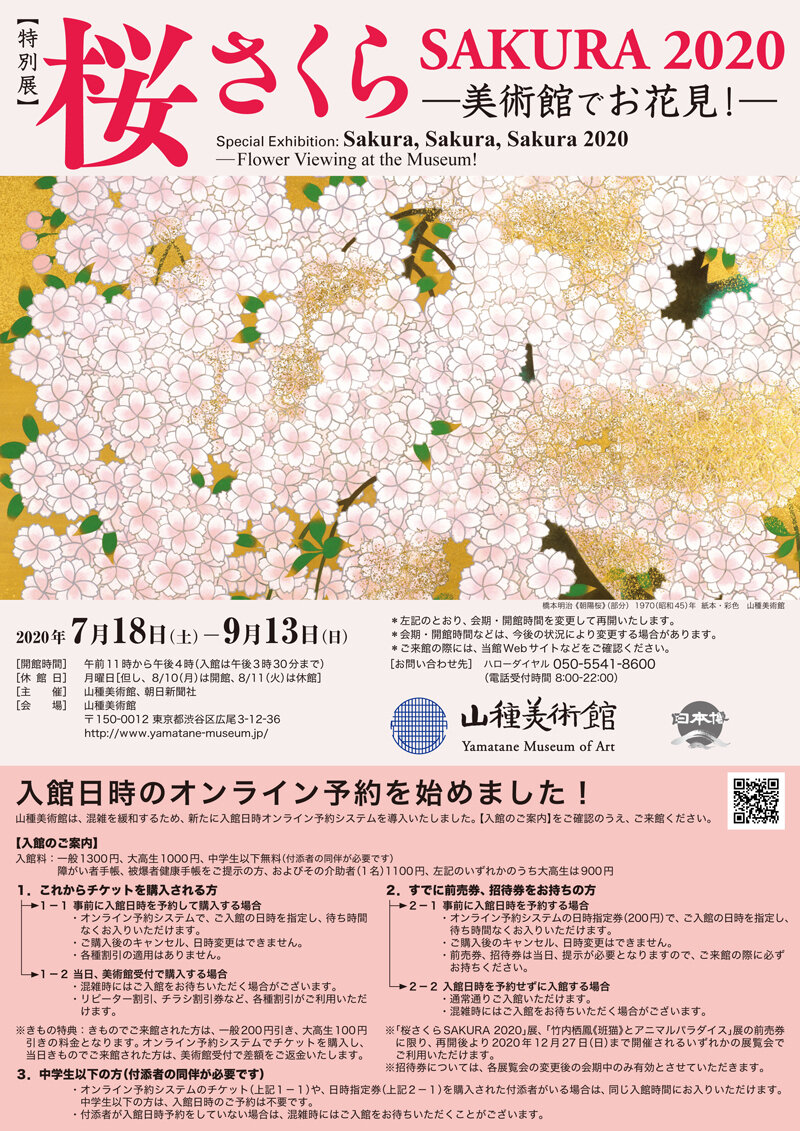
The Yamatane Museum of Art holds a special exhibition of paintings of cherry blossoms, a beloved symbol of Japan. Cherry trees have long grown wild in Japan, on its mountains and lowlands. In the middle ages and the early modern period, aristocrats, samurai, and others in the upper reaches of society admired the cherry trees growing by their homes or in famous places. In the Edo period, a great number of new varieties were bred, cherry-blossom viewing became a custom widely observed by the common people, and the Japanese attachment to the cherry blossom grew broader and deeper. The cherry blossom, so beautiful in full bloom and so evanescent, its petals swiftly scattering, has long been celebrated in poetry, incorporated in designs for furnishings and other objects, and depicted in paintings.
This exhibition, focusing on the cherry blossom with its deep ties to the Japanese aesthetic, introduces about fifty modern and contemporary nihonga from our collection. Hishida Shunsō's Women Viewing Cherry Blossoms depicts ladies gathered beneath trees in full bloom. Okumura Togyū's Spring in Yoshino takes Nara's Mount Yoshino, famous for its cherry trees, as its subject. Hashimoto Meiji's Cherry Tree in Morning Sun addresses the Miharu Takizakura, a famous thousand-year-old cherry tree in Fukushima. Hashimoto Gahō's Kojima Takanori, a Heroic Samurai depicts the "cherry tree of loyalty" episode from the Taiheiki. Famous places, manners and customs, grand narratives: cherry trees play leading roles in works on scores of themes.
Paintings of cherry trees are in full bloom in our museum. We hope you will enjoy the many portraits of the cherry tree that modern and contemporary nihonga artists have created.
Hashimoto Gahō, Kojima Takanori, a Heroic Samurai: Scene from the Taiheiki (Chronicle of the Great Peace). Color on Silk, Meiji Period, c. 1899; Yamatane Museum of Art
Yokoyama Taikan, Mountain Cherry Trees. Color on Silk, Shōwa Period, 1934; Yamatane Museum of Art
Hishida Shunsō, Women Viewing Cherry Blossoms. Color on Silk, Meiji Period, 1894; Yamatane Museum of Art
Matsuoka Eikyū, Court Ladies in Spring Clothing, in the Spring Sunlight. Color on Silk, Taishō Period, 1917; Yamatane Museum of Art
Kobayashi Kokei, Cherry Blossoms. Color on Silk, Shōwa Period, c. 1933; Yamatane Museum of Art
Tsuchida Bakusen, Oharame, Women Peddlers. Color on Gold-Leafed Silk Gauze, Taishō Period, 1915; Yamatane Museum of Art
Okumura Togyū, Cherry Blossoms at Daigo-ji Temple. Color on Paper, Shōwa Period, 1972; Yamatane Museum of Art
Okumura Togyū, Spring in Yoshino. Color on Paper, Shōwa Period, 1977; Yamatane Museum of Art
Hayami Gyoshū, Cherry Blossoms in the Dark. Color on Silk, Shōwa Period, 1928; Yamatane Museum of Art
Hashimoto Meiji, Cherry Tree in Morning Sun. Color on Paper, Shōwa Period, 1970; Yamatane Museum of Art
Approximately 50 works in total are to be displayed.
*All works are the property of the Yamatane Museum of Art.
Adults: 1,300 yen; university and high school students, middle school and younger children: free of charge (middle school and younger children must be accompanied by an adult)
Disability ID holders and one person accompanying them: 1,100 yen
*[4 August – 13 September] Admission is free for university and high school students.
*Discount for those wearing kimono: Discount of 200 yen for adults.
*Discounts and special offers cannot be combined.


